
Valve has quietly rolled out an update for Counter-Strike 2 (CS2) that introduces a community review system designed to identify players suspected of cheating. This feature is integrated with VACNet, Valve's proprietary anti-cheating technology.
Community Review System Overview
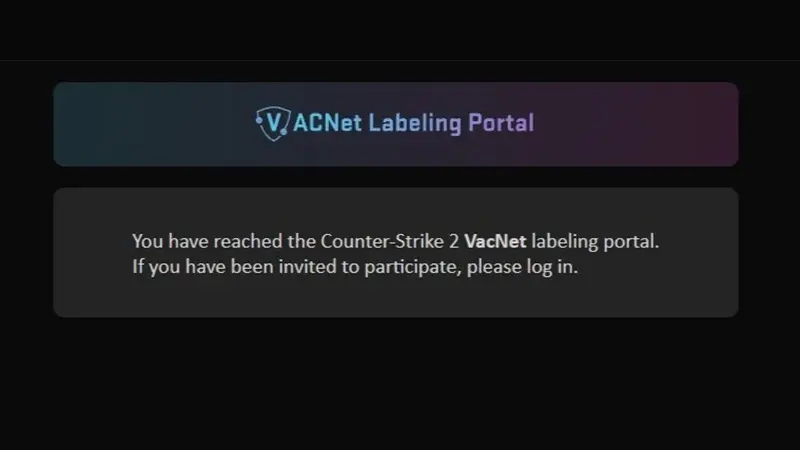
Initially, the new review feature is available only to a select group of players who receive direct invitations through CS2. Alongside this, Valve has set up a dedicated portal at counter-strike.net/vacnet, allowing these chosen players to view demo clips of matches suspected of containing cheating activities. Participants in the review process are required to assess these clips, which will aid in training the VACNet detection model.
How the Review Process Works
Players who are granted access will receive notification via the main menu of CS2, appearing in the upper left corner of the screen. Upon accepting the invitation, they must authenticate their Steam account through the VACNet portal to begin reviewing assigned cases. For each case, reviewers evaluate whether the player in the footage is committing one of four types of cheating.
Evaluation Criteria for Reviewers
After viewing the demo, reviewers have three options for their assessment: cheat present, insufficient evidence, or no cheat. It's important to note that a reviewer's judgment does not directly lead to penalties for the accounts under scrutiny. Instead, the data collected from these assessments will contribute to enhancing the VACNet model in the future. Valve emphasizes that reviewers should be confident in their evaluations, particularly when indicating that cheating is present, to minimize misclassification of innocent players.
Limited Access and Future Implications
Currently, access to the VACNet review system is restricted to a small number of players, and Valve has not disclosed the criteria used to select participants. This selective distribution is reminiscent of the early access phase of Counter-Strike 2. While some controversies have already surfaced, including a case involving a player with a Premier Rating of 16,000 who previously participated in the Overwatch system from Counter-Strike: Global Offensive (CS), Valve has not confirmed whether prior experience in Overwatch or specific rating levels are prerequisites for access.
Players with access can invite one friend to participate, and additional invitations may open up as they complete various assessments. This gradual approach appears to be Valve's strategy to expand the pool of reviewers without overwhelming the system.
Valve has issued a strict warning to VACNet reviewers, prohibiting them from streaming, recording, or sharing the demo clips they analyze. This confidentiality is critical, as any leaks regarding what behaviors the system monitors could potentially inform cheat developers, allowing them to modify their software to evade detection.
The new review system bears similarities to the previous Overwatch system but has a crucial distinction: individual reviewer assessments do not immediately result in player penalties. Instead, aggregated evaluations will provide additional data for the ongoing development of VACNet. Currently, there are no indications that players will receive experience points or rewards for participating, a stark contrast to the previous Overwatch mechanism.
The introduction of the VACNet review system marks an exciting development in Valve's efforts to combat cheating in CS2. By combining automated analysis through VACNet with human assessment, Valve aims to create a more robust dataset for identifying suspicious gameplay patterns. However, as this feature is still in a limited testing phase, its overall effectiveness remains to be fully evaluated.
As Valve continues to refine this system, it will be interesting to see whether it will evolve into a comprehensive replacement for Overwatch or develop into a new mechanism integrated fully with VACNet.
Source: https://www.esports.id/read/sinyal-reborn-overwatch-valve-diam-diam-rilis-fitur-review-cheat-cs2-berbasis-vacnet-19265