
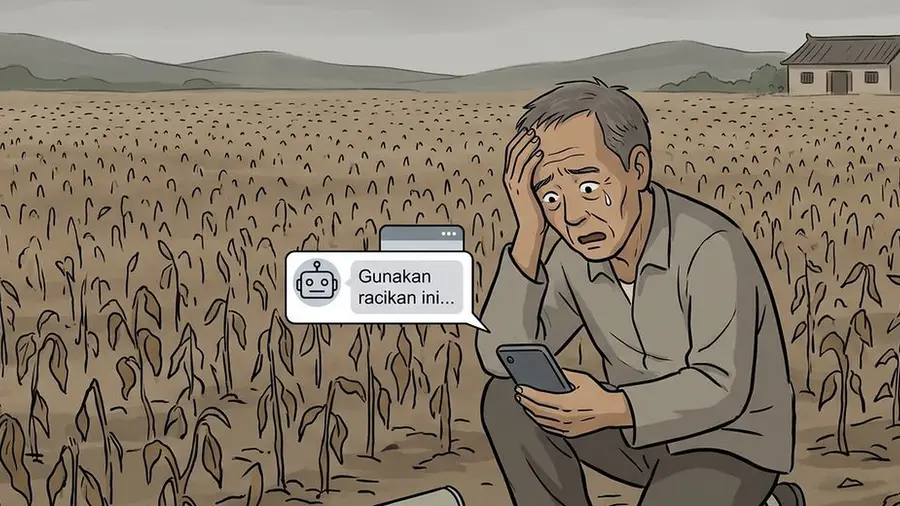
A farmer in Chuzhou, China, experienced a devastating loss of his entire harvest from 10 hectares of land, just a day after following recommendations from an AI chatbot regarding pest and weed management. Wu, a 67-year-old farmer, had been utilizing AI applications for farming for a year, gradually building trust in the technology's advice.
Initial Skepticism Transforms into Trust
Initially, Wu was skeptical about the suggestions provided by the AI chatbot. However, after months of seeing positive results that improved the efficiency of his farming operations, he began to believe that this intelligent machine had comprehensive knowledge that could not possibly be wrong.
AI Recommendations and Their Consequences
The trouble began when Wu faced a serious problem with weeds and pests on his farm. Confident in the AI's capabilities, he consulted the chatbot for advice on effective pesticide formulations. The AI responded promptly, providing detailed instructions on the chemical components to mix, along with specific dosage recommendations.
The AI suggested using a highly efficient chemical known as flupyrimethalin and flusulfasulfaether for weed control, combined with thiamethoxazine and methyl salt for pest management. Without hesitation and without consulting agricultural extension workers, Wu followed the AI's instructions to prepare the pesticide mixture.
Devastating Results Overnight
The next day, the consequences of the AI's erroneous advice became evident. Not only did the weeds die, but the sesame seedlings across the 10 hectares perished overnight, as reported by Taiwan's media outlet CTWANT. When Wu inquired with the AI about the cause of the crop failure, the chatbot pointed to flusulfasulfaether as the culprit.
Expert Opinions on the AI's Recommendation
Experts consulted on the matter clarified that flusulfasulfaether is intended specifically for controlling broadleaf weeds in soybean fields. The US Department of Agriculture classifies sesame as a broadleaf crop, making it susceptible to the herbicide's effects. Furthermore, this chemical should ideally be applied selectively to targeted areas, rather than over the entire field.
Wu expressed frustration that the AI did not warn him about the risks associated with its recommendations. Although the chatbot's interface included a general disclaimer stating, 'AI results may be incorrect, please verify,' Wu felt this warning was insufficient. Some readers even speculated that the chemical flusulfasulfaether mentioned by the AI might not exist at all, suggesting it could be a fabrication by the chatbot.
This incident highlights the potential dangers of relying heavily on AI in agriculture without adequate verification and understanding of the technology's limitations.
Source: https://tekno.kompas.com/read/2026/08/18/14010097/setelah-setahun-percaya-ai-petani-ini-gagal-panen-10-hektare-dalam-semalam?source=terpopuler_artikel