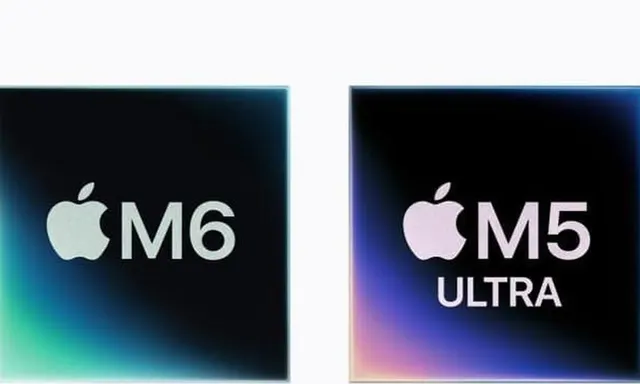
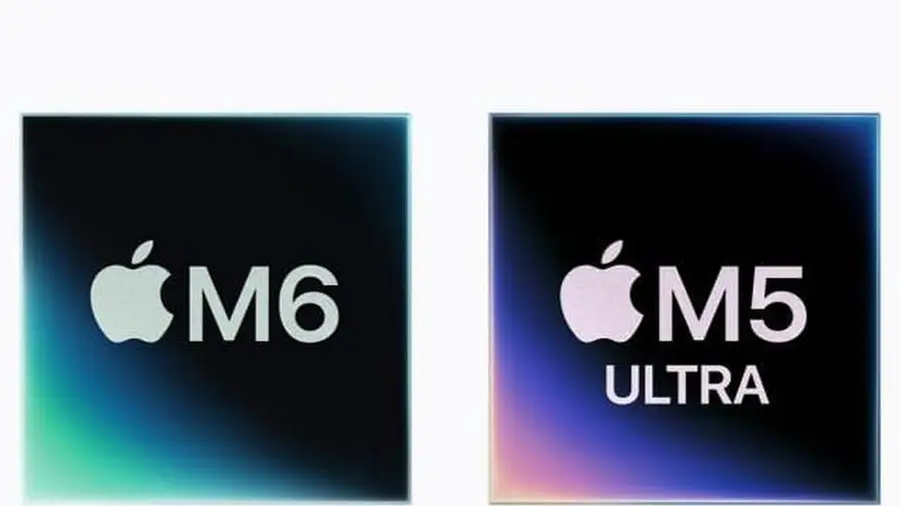
Apple has officially launched two new chips for its Mac computers: the M6 and M5 Ultra. The M6 is notable for being the first chip from Apple manufactured using a 2-nanometer (nm) fabrication process, while the M5 Ultra is touted as the most powerful chip the company has ever produced.
Performance Enhancements in the M6 Chip
The M6 chip is designed to significantly enhance performance, particularly in artificial intelligence (AI) applications. According to Sri Santhanam, Vice President of Silicon Engineering at Apple, these chips represent a substantial advancement in AI and computing performance for Apple silicon.
The M6 features a 12-core CPU, an increase of two cores compared to its predecessor, the M5. Its architecture includes two super cores, four performance cores, and six efficiency cores. Apple’s internal tests suggest that the M6 offers multithreaded performance that is 1.2 times faster than the M5 and up to 2.4 times quicker than the M1.
Advanced Graphics Capabilities
In addition to the CPU improvements, the M6 includes a 12-core GPU, which also boasts two additional cores compared to the previous model. Each GPU core is equipped with a Neural Accelerator designed to speed up AI processing tasks. The GPU's AI computing capabilities are reported to be nearly 30% better than those of the M5 and over eight times faster than the M1.
Introducing the M5 Ultra for Professionals
The M5 Ultra is specifically targeted at professionals who require high-performance computing for tasks such as 3D rendering, visual effects, scientific analysis, and running large AI models locally. This chip employs a new UltraFusion technology, linking two dual-die M5 Max chips to create a quad-die architecture, which is a first for Apple silicon.
With a CPU that can reach up to 36 cores—comprising 12 super cores and 24 performance cores—the M5 Ultra’s multithreaded performance is claimed to be 1.3 times greater than that of the M3 Ultra. Furthermore, the GPU can be configured with up to 80 cores, with each core also featuring a Neural Accelerator, leading to an AI computing capability that is reported to be 4.5 times higher than that of the M3 Ultra.
Memory and Bandwidth Improvements
Apple has also enhanced the memory capabilities of both chips. The M6 supports unified memory of up to 32 GB with a bandwidth of 170 GB/s, which is around 10% higher than the M5. Meanwhile, the M5 Ultra supports an impressive unified memory capacity of up to 512 GB, with a bandwidth of 1.2 TB/s, representing a 50% increase over the M3 Ultra. This capacity allows Macs to run large language models (LLMs) with hundreds of billions of parameters directly on the device, reducing reliance on cloud computing.
In addition, the M5 Ultra includes a 32-core Neural Engine and a Media Engine that accelerates formats such as H.264, HEVC, ProRes, and AV1.
Developers can leverage the capabilities of the M6 and M5 Ultra through frameworks such as Core AI, Core ML, Metal, and Xcode, enabling them to run and fine-tune AI models locally on their Macs.
Source: https://inet.detik.com/consumer/d-8634189/apple-rilis-chip-m6-2-nm-dan-m5-ultra-ngebut-untuk-ai