
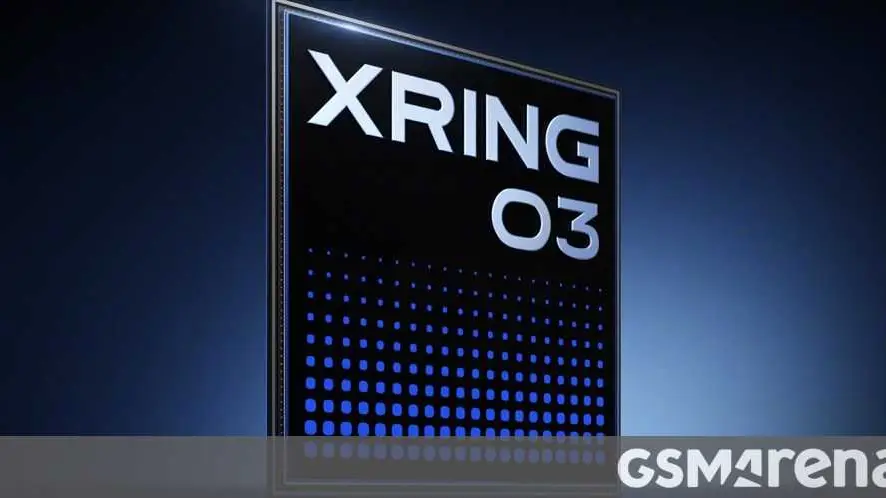
Xiaomi has unveiled that its upcoming Xiaomi 18 Fold smartphone will feature the in-house Xring O3 chip, which is a successor to the previously released Xring O1. Interestingly, the company decided to skip the O2, indicating the O3's impressive capabilities. According to an examination by Geekerwan, this new chip boasts a remarkable two-generations leap in energy efficiency compared to its predecessor.
Technical Specifications of the Xring O3
The Xring O3 employs a 3nm manufacturing process known as N3P, which is an enhancement over the N3E technology used for the O1. This same process is also utilized in the outgoing Dimensity 9500 and Snapdragon 8 Elite Gen 5 chips. In contrast, the upcoming Dimensity 9600 and Snapdragon 8 Elite Gen 6 chips are expected to be fabricated using a more advanced 2nm node.
Performance Insights
Despite utilizing older technology, the Xring O3 is positioned to compete with the latest chips from competitors like MediaTek and Qualcomm. Xiaomi has incorporated Arm’s C1 series CPU cores within the chip, which are already present in the Dimensity 9500 and Exynos 2600. In contrast, the anticipated Dimensity 9600 is likely to transition to the newer C2 series CPU cores.
The performance metrics of the Xring O3 are impressive. It surpasses the Dimensity 9500 in both performance and energy efficiency, coming close to matching Apple’s A19 CPU cores. When pushed to its limits, the CPU achieves multi-core Geekbench scores of around 15,000 points, rivaling the performance of Apple’s M5 chip. However, at such high performance levels, power consumption exceeds 20W, which is impractical for mobile devices. Under more typical usage scenarios, the chip can score approximately 12,000 points, equivalent to the Snapdragon 8 Elite Gen 5, but at only half the power consumption.
Innovative GPU Features
While the CPU incorporates older cores, the GPU is entirely new, featuring the Arm G2-Ultra NX MC16. This 16-core GPU includes two types of cores: standard and those with the NX extension, designed to enhance AI-driven image upscaling and frame generation for gaming. This powerful GPU is expected to deliver performance that could rival laptops equipped with Intel’s Lunar Lake processors and approach the capabilities of M5-powered MacBooks. For mobile applications, it offers outstanding performance and energy efficiency, outshining both the Apple A19 Pro and Dimensity 9500 GPUs.
Memory and NPU Performance
The Xring O3 chip was tested on a development board featuring LPDDR6 RAM, which provides a data bus of 24 bits compared to the 16 bits of LPDDR5X. This setup, with four modules creating a 96-bit bus at 10,667MT, achieves a bandwidth of 113.8GB/s. However, it remains uncertain whether such configurations can be integrated into commercial phones, as LPDDR6 is more expensive than its predecessor.
Additionally, the chip includes a custom-designed NPU capable of delivering a significant performance of 200 TOPS using INT4. It features 8MB of L2 cache, while the entire chip comes with 16MB of SLC cache. Despite its size of 138.3mm², which is larger than the Snapdragon 8 Elite Gen 5, the Xring O3 does not include an on-board modem, indicating a compact design for its powerful capabilities.
One area for improvement is the chip's packaging. The Xring O3 utilizes an older Package-on-Package method, which stacks RAM directly over the chipset. Although this design minimizes connection lengths, it can hinder cooling efficiency. A more contemporary approach would involve placing the chipset and RAM side by side to improve thermal management.
As the development of the Xring O3 progresses, it will be intriguing to see how it competes against next-generation offerings from MediaTek, Qualcomm, Samsung, and Apple. While these competitors may have a node advantage, Xiaomi’s advanced design features could allow the O3 to maintain competitiveness in the market.
Source: https://www.gsmarena.com/xiaomis_xring_o3_examined__at_least_a_twogenerations_leap_in_power_efficiency-news-74348.php